
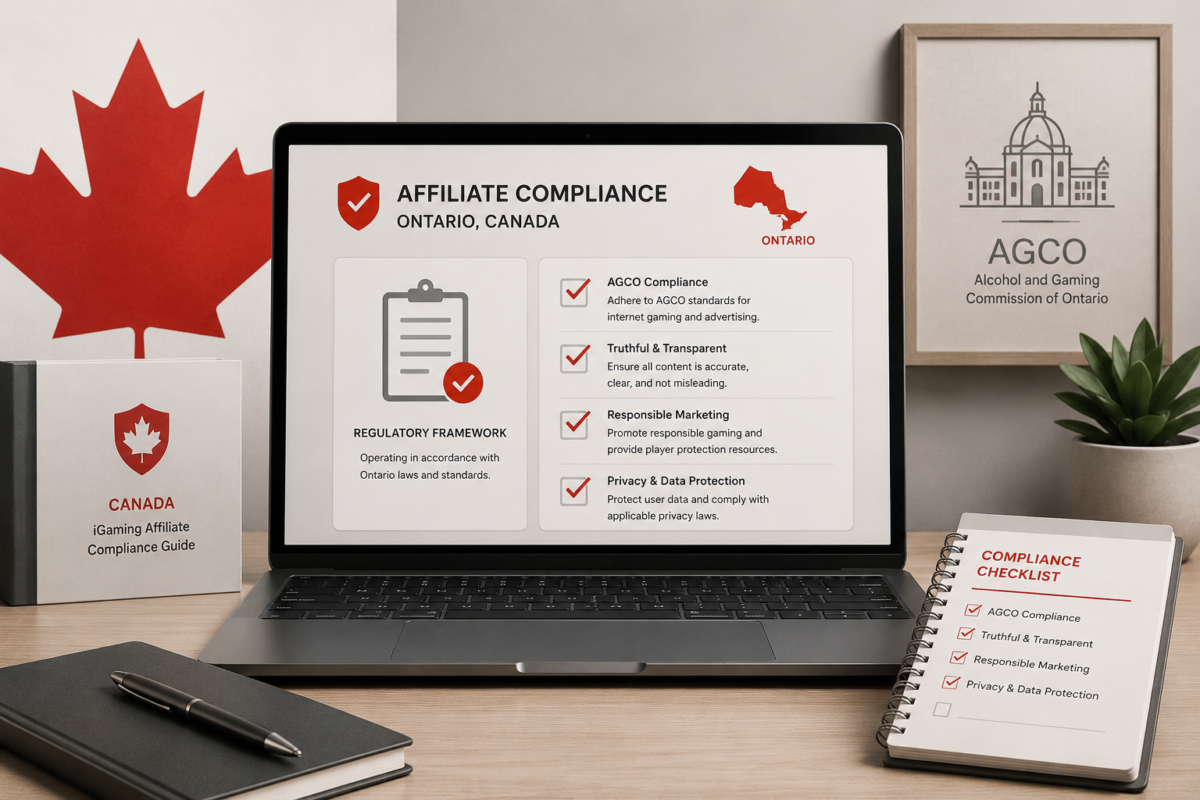
Operating as a casino affiliate in Ontario is unlike working in any other Canadian province, and unlike any regulated market in Europe or the United States. Ontario is neither a state monopoly nor a fully open market. It runs a controlled private market where multiple licensed operators compete, but only those with an active operating agreement with iGaming Ontario (iGO) may legally accept Ontario players. Every operator that serves Ontario residents without that agreement does so outside provincial law, regardless of where else it holds a licence. That single structural fact determines what compliant casino affiliate Ontario content looks like.
Affiliates entering Ontario for the first time frequently underestimate how specific the compliance requirements are. Understanding casino affiliate Ontario E-E-A-T, meaning how Google assesses trust and expertise for gambling sites targeting Ontario players, matters as much as understanding the legal rules. Compliance is not passive. An affiliate that simply avoids the most obviously unlicensed sites is not necessarily operating within the framework. The obligation is to actively direct Ontario players toward iGO-registered operators and to meet Ontario-specific standards in every piece of content, every link, and every responsible gambling disclosure.
Who Regulates Casino Affiliates in Ontario?
Two bodies share authority over Ontario’s online gambling market.
The Alcohol and Gaming Commission of Ontario (AGCO) is the provincial regulator. It sets the rules, publishes the Registrar’s Standards for Internet Gaming, monitors compliance, and has enforcement powers over all gambling activity in the province. The AGCO can take action against operators, and through them, against affiliates whose conduct breaches provincial standards.
iGaming Ontario (iGO) is a subsidiary of the AGCO that functions as the market operator. It signs operating agreements with private operators, sets the commercial framework, and holds those operators contractually accountable for how they and their affiliates behave. This creates a direct enforcement chain: the AGCO holds iGO accountable, iGO holds operators accountable, and operators are required to ensure their affiliates comply with Ontario’s standards.
Ontario’s regulated market launched in April 2022, making it one of the youngest private iGaming markets anywhere. The AGCO has nonetheless moved quickly to enforce its standards and has demonstrated a clear willingness to take action where operators or their partners fail to meet them.
The Ontario Market Structure: Open but Strictly Bounded
Ontario’s framework is often described as an open market, but that description requires qualification. Any private operator can apply to iGO for an operating agreement, and dozens have done so. The market is not a monopoly. However, it is explicitly closed to operators who have not completed that registration process. An operator licensed in Malta, Gibraltar, Kahnawake, or any other jurisdiction is not authorised to serve Ontario players unless it also holds a current iGO operating agreement.
For affiliates, this distinction is decisive. A casino affiliate Ontario site that lists, rates, reviews, compares, or links to operators without a current iGO agreement is directing Ontario residents to unregistered gambling. This applies whether or not the affiliate intends to target Ontario specifically. If Ontario residents can access those links, the site is functionally promoting unregistered operators to them.
What Affiliates Can and Cannot Promote
The AGCO publishes a list of operators with active iGO operating agreements. Only those operators may be promoted to Ontario audiences. The list changes as operators join or leave the market, so affiliates need to check it regularly rather than relying on a historical snapshot.
Beyond the question of which operators to promote, Ontario also governs how they are promoted. Specific restrictions apply to:
- Bonus and promotional offers, which must be accurately described and not misrepresent terms or conditions
- Odds and probability claims, which must be factually accurate and not imply that skill or strategy can overcome chance in games of pure chance
- Testimonials and endorsements, which must be verifiable and not fabricated
- Content targeting, which must not reach persons who have self-excluded or who are otherwise identified as high-risk
- Calls to action, which must not use countdown timers, high-pressure language, or coercive formats
Each of these restrictions applies to affiliate content directly, not only to operator websites.
Ontario’s Compliance Requirements for Casino Affiliates
The AGCO’s Registrar’s Standards, together with iGO’s operator agreements and Ontario’s consumer protection legislation, create four core obligations that every Ontario-facing casino affiliate must meet.
1. Channelling to Registered Operators Only
Affiliates must not advertise, rate, review, compare, link to, or display any URL of an operator that does not hold a current iGO operating agreement. Indirect promotion is also prohibited. A comparison table that includes unregistered operators alongside registered ones, even without explicitly recommending the unregistered option, fails this requirement.
2. Age Verification and Protected Persons
Ontario sets the minimum gambling age at 19. Every webpage of an Ontario-facing affiliate site must carry a clearly visible 19+ indicator accompanied by a responsible gambling message. This requirement applies to social media content and any other marketing format, not only the affiliate’s main website. Affiliates must ensure that their content, imagery, and tone do not appeal to persons under 19, either directly or indirectly. Marketing must also not target persons who have self-excluded or who are identified as high-risk players.
3. Accurate and Balanced Content
Ontario prohibits a range of content practices that are common in less regulated markets. Affiliates must not:
- Misrepresent the nature, odds, risks, or costs of any gambling product
- Imply that players can influence the outcome of games of pure chance
- Suggest that longer play or higher spend increases the probability of winning
- Describe gambling as risk-free or downplay fees and charges
- Present gambling as a solution to financial or personal problems
- Encourage excessive or irresponsible gambling behaviour
- Use aggressive tactics such as countdown timers or high-pressure sales language
4. Responsible Gambling Information on Every Page
Ontario requires affiliates to make responsible gambling information accessible from every page of their website. That information must cover all of the following:
- How games work and common misconceptions about odds and outcomes
- Lower-risk gambling behaviours and how responsible gambling tools function
- Information about deposit limits, session limits, and time-based controls
- Details of self-exclusion programs, including Ontario’s self-exclusion tool available through GameSense.ca
- Contact details for support services, including ConnexOntario at 1-866-531-2600 and the Problem Gambling Helpline
Casino Affiliate Ontario E-E-A-T: How Compliance Affects Search Visibility
Google classifies gambling content under its YMYL framework, which stands for Your Money or Your Life. Sites in this category face stricter quality assessment than the average web page. Google evaluates them using E-E-A-T: Experience, Expertise, Authoritativeness, and Trustworthiness. For a casino affiliate in Ontario, each of those four pillars has a specific and non-generic meaning.
Experience and Expertise
A site that accurately names only iGO-registered operators, correctly states Ontario’s minimum gambling age, explains the AGCO’s advertising standards, and includes Ontario-specific responsible gambling resources signals real experience of this market. Generic casino affiliate content that treats Ontario as interchangeable with the rest of Canada, or that promotes unregistered operators, signals the opposite.
Ontario is particularly demanding in this respect because the market is live and evolving. The iGO operator list changes. The AGCO issues updated guidance. Operators enter and exit the market. A site that was accurate two years ago may not be accurate today. Demonstrating ongoing expertise, the ability to keep pace with a developing regulatory environment, is therefore a genuine E-E-A-T signal rather than a one-time compliance task.
Authoritativeness and Trustworthiness
Authoritativeness requires external recognition from parties other than the site itself. For a casino affiliate Ontario site, the most credible form of recognition is a documented working relationship with iGO-registered operators, supported by independent third-party compliance certification.
Trustworthiness cannot be self-declared. That signal must come from an independent organisation that has reviewed the site and confirmed it meets Ontario’s standards. Ontario’s consumer protection culture, active media environment, and engaged regulators mean that external validation carries material weight, both in search engine assessment and in operators’ decisions about which affiliates they are willing to work with.
How QMRA Certifies Casino Affiliate Compliance in Ontario
QMRA is an independent compliance organisation. Its legal specialists review affiliate websites against the gambling legislation and regulatory standards of each market it covers. For Ontario, that means the full AGCO Registrar’s Standards framework, iGO’s operator agreement requirements, and Ontario’s consumer protection obligations. The review covers channelling, advertising restrictions, responsible gambling content, and age verification standards. Qualified lawyers conduct every review. Details of the process are on the QMRA how-it-works page.
The certification process runs in four steps:
- Step 1: QMRA’s legal team reviews your site against all applicable Ontario obligations and produces a written compliance report identifying any gaps.
- Step 2: You address the specific findings set out in the report.
- Step 3: QMRA carries out a second review to confirm the issues have been resolved.
- Step 4: If your site meets the standard, you receive the QMRA Quality Mark for 12 months and permission to display the logo with a link to the QMRA Ontario market page.
That backlink carries value beyond referral traffic. A link from a legally grounded compliance domain tells search engines that an independent organisation has reviewed your site and confirmed it operates within Ontario law. This directly supports the Trustworthiness and Authoritativeness components of your E-E-A-T profile. It also gives iGO-registered operators the documented compliance evidence they increasingly require before entering into affiliate agreements, particularly because operators bear contractual responsibility for their affiliates’ conduct under the iGO framework.
AI Search Visibility for Ontario Casino Affiliate Sites
E-E-A-T is not only a Google ranking metric. AI systems including Google’s AI Overview, ChatGPT, and Perplexity use the same underlying signals to decide which sources to cite when generating answers. When someone in Ontario asks which gambling sites are legally registered, what a casino affiliate is allowed to promote, or how self-exclusion works in the province, these systems pull answers from sources they regard as credible and independently verified.
Third-party validation is one of the primary signals those systems use. QMRA already appears in AI system citations across multiple regulated markets. A backlink from qmra.eu connects your site to a domain these systems recognise as a compliance authority. As AI-assisted search continues to grow as a traffic channel, that connection can increase how often your content surfaces in AI-generated responses about legal gambling in Ontario, which adds a layer of visibility that operates independently of traditional organic rankings.
Getting Started as a Compliant Ontario Casino Affiliate
Ontario is not a market where partial compliance is a viable position. The regulatory framework is enforced through a chain of contractual accountability that runs from the AGCO through iGO to operators and then to their affiliates. A site that falls outside the framework creates legal and commercial risk for itself and for every registered operator it partners with.
An independent legal review is therefore not simply a search engine optimisation exercise. It is the prerequisite for working with iGO-registered operators in a market where those operators are contractually accountable for what their affiliates do. QMRA issues the Quality Mark after a completed legal review based on Ontario’s actual gambling legislation and AGCO standards. To apply, visit qmra.eu/become-member.
FAQ: Casino Affiliate Ontario
Can a casino affiliate in Ontario promote international online casinos?
Only if those operators hold a current iGO operating agreement. Operators licensed in Malta, Gibraltar, Kahnawake, or any other jurisdiction are not authorised to serve Ontario players unless they have also registered with iGaming Ontario. Promoting unregistered operators to Ontario audiences, regardless of those operators’ international licensing, means directing Ontario residents to unregistered gambling activity under provincial law.
What is iGaming Ontario and why does it matter for affiliates?
iGaming Ontario is a subsidiary of the AGCO that acts as the market operator for Ontario’s private online gambling market. All private operators who want to legally accept Ontario players must enter into an operating agreement with iGO. That agreement makes operators contractually responsible for the conduct of their affiliates. If an affiliate promotes non-compliant content, the operator’s iGO agreement is at risk. This accountability chain means affiliate compliance is a commercial prerequisite for operator partnerships in Ontario, not only a legal obligation.
What age restriction applies to casino affiliate advertising in Ontario?
The minimum legal gambling age in Ontario is 19. Every page of an Ontario-facing affiliate website must display a clearly visible 19+ indicator accompanied by a responsible gambling message. Content, imagery, tone, and design must not appeal to persons under 19, either directly or indirectly. This requirement extends to social media posts and any other marketing format the affiliate uses.
What responsible gambling content must an Ontario casino affiliate include?
Ontario requires responsible gambling information to be accessible from every page of the affiliate’s website. Required content includes how games work and common misconceptions about odds, information on lower-risk gambling behaviours and responsible gambling tools, details of deposit and time limits and self-exclusion programs, and contact information for support services. Affiliates must reference ConnexOntario at 1-866-531-2600, the Problem Gambling Helpline, and Ontario’s self-exclusion program available through GameSense.ca.
How does the QMRA Quality Mark benefit a casino affiliate in Ontario?
The QMRA Quality Mark provides two concrete benefits in the Ontario market. First, it gives iGO-registered operators the independent compliance documentation they require before entering into affiliate agreements, which is particularly important because operators bear contractual responsibility for their affiliates’ conduct under the iGO framework. Second, it provides a backlink from a compliance-verified domain that supports the Trustworthiness and Authoritativeness components of the affiliate’s E-E-A-T profile. QMRA also appears in AI system citations, which can increase how often a certified site is referenced in AI-generated responses about legal gambling in Ontario.
Does QMRA certification cover the rest of Canada or only Ontario?
QMRA’s Ontario certification covers the Ontario-specific framework: the AGCO Registrar’s Standards, iGO operating agreement requirements, and Ontario’s responsible gambling obligations. Ontario is the only province in Canada with a privately operated, regulated online gambling market of this structure. The rest of Canada operates under different federal and provincial arrangements. QMRA’s Ontario certification does not extend to other Canadian provinces, and affiliates targeting multiple Canadian jurisdictions should seek jurisdiction-specific legal advice for each market they operate in.

