
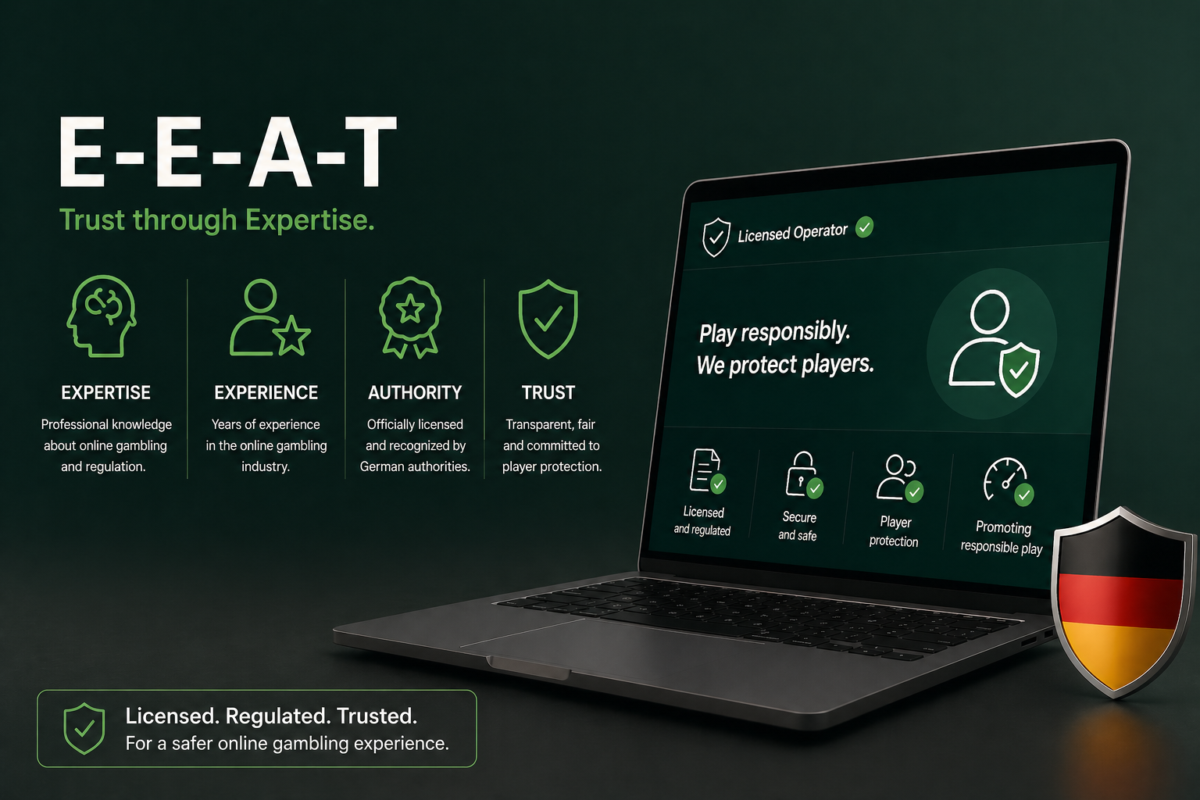
Germany affiliate E-E-A-T is not an abstract SEO concept. It is a practical problem with a specific shape. Google evaluates casino affiliate sites under its YMYL classification, Your Money or Your Life. YMYL applies to content that can materially affect a person’s finances. The E-E-A-T framework covers Experience, Expertise, Authoritativeness, and Trustworthiness. This is how Google determines whether a site is fit to rank for those queries. In Germany, each of those four pillars has a concrete, legally grounded meaning. A site that cannot satisfy all four in the German context will lose ground to sites that can.
Germany’s gambling market has one of the strictest regulatory frameworks in Europe. The GlüStV 2021, the Interstate Treaty on Gambling, created a federal licensing structure. The GGL, Gemeinsame Glücksspielbehörde der Länder, enforces it as the central authority since 2023. In 2024, the GGL issued 231 cease-and-desist proceedings, of which 148 targeted advertising violations by affiliates and comparison portals directly. For a broader explanation of the E-E-A-T framework as it applies to casino affiliates across all markets, see how the QMRA Quality Mark strengthens E-E-A-T for casino affiliates. This article focuses on what each pillar requires specifically in Germany.
Experience: What It Looks Like for a Germany Affiliate E-E-A-T Site
Experience is the first E in E-E-A-T. Google added it in 2022 to distinguish between content written from personal, first-hand engagement and content assembled from secondary sources. For a German casino affiliate, Experience means showing that content reflects genuine knowledge of the market, not generic information repackaged for a German-language audience.
What Genuine German Market Experience Signals to Google
An affiliate with real experience of the German market writes about the distinction between GGL-licensed virtual slots and state-licensed table games. That distinction matters to German players. It explains LUGAS and the €1,000 cross-operator deposit limit, because that is part of the daily reality of gambling in Germany. It references the GGL’s enforcement approach toward affiliates, because that shapes what a responsible affiliate site does. These are not details a content farm producing generic European casino content would include. Google’s quality raters are trained to spot the difference.
Content Depth as an Experience Signal
Shallow content about German casinos, such as operator lists with no regulatory context or bonus comparisons that ignore legal restrictions, signals low experience. Content that explains the GlüStV 2021 definition of ‘online casino’, why progressive jackpots are prohibited for virtual slot games, or why only Schleswig-Holstein and Bavaria currently licence table game providers signals genuine familiarity with the German market. Experience is demonstrated through specificity, not through volume.
Expertise: The Author and Legal Knowledge Signal in Germany
Who Produces the Content and What They Know
Expertise is the second pillar. It concerns whether the people who produce the content have genuine knowledge of the subject. For German gambling content, this means understanding not just what games are available but what the legal framework governing them says. The GlüStV 2021 is a technically complex document. The distinction between federal GGL licences and state-level licences is not intuitive. German advertising restrictions go further than most affiliates realise. They prohibit specific content formats, time-of-day placements, and endorsements by active athletes, not just misleading claims.
Legal Compliance as a Proxy for Expertise
A site that correctly explains the GGL licensing framework, accurately describes the responsible gambling obligations under the GlüStV 2021, and references the GGL whitelist as the authoritative source for operator status signals legal expertise. A site that uses ‘online casino Germany’ loosely, or that fails to distinguish GGL-licensed from state-licensed games, signals the opposite. In Germany’s heavily regulated market, legal accuracy is not just a compliance requirement. It is an expertise signal that quality raters are looking for.
Authoritativeness: How Germany’s Regulated Market Creates the Benchmark
Authoritativeness is the third pillar. Google evaluates it by looking at whether other credible sources recognise and reference a site. In the German iGaming context, the most meaningful recognition comes from GGL-licensed operators who have vetted and partnered with the affiliate, and from external organisations that have independently verified compliance with German gambling law.
Operator Recognition as an Authority Signal
Germany’s online gambling market generated €4.22 billion in GGR in 2024. The operators active in this market have invested heavily in their licences, each costing €7 million for a nine-year term. These operators conduct thorough due diligence before signing affiliate agreements. An affiliate with active partnerships across multiple GGL-licensed operators has been assessed by organisations that are themselves recognised authorities in the German market. That recognition flows back to the affiliate’s authority profile.
Third-Party Compliance Verification as Authority
Independent compliance verification adds another layer. A quality mark from an organisation that has legally reviewed the affiliate’s site and confirmed it meets the GlüStV 2021 standard counts as third-party recognition. It tells search engines that an expert external body has assessed the site and found it authoritative enough to certify. According to DLA Piper’s analysis of European gambling enforcement, illegal gambling represented 71% of EU market revenue in 2024. In that environment, demonstrated legitimacy carries significant weight in authority assessments.
Trustworthiness: The Hardest Germany Affiliate E-E-A-T Pillar to Build
Trustworthiness is the fourth and most important pillar for YMYL sites. Google treats it as the foundation on which the other three rest. For a German casino affiliate, Trustworthiness means demonstrable, externally verified evidence that the site operates within German law. It is also the pillar that takes the longest to establish and the hardest to fake.
Why Self-Declared Compliance Does Not Work
An affiliate cannot declare itself trustworthy. A page titled ‘About Our Compliance’ or ‘Why We Are Safe’ does not constitute a trust signal. Trust signals must come from outside the site. In Germany, the trust signals that carry weight are GGL-licensed operators who have signed with the affiliate, independent legal organisations that have certified the site, and backlinks from domains that search engines associate with regulated content. None of these can be self-generated.
The Black Market Context That Makes Trust So Difficult
Germany has a severe black market problem. The German Sports Betting Association (DSWV) counted 382 illegal German-language betting sites against just 34 licensed operators in 2024. Many of those illegal sites use professional-looking design, SEO-optimised content, and affiliate networks to appear legitimate. Google’s quality raters are specifically trained to distinguish between genuine compliance signals and cosmetic ones. A detailed analysis of the ICLG Germany gambling law framework shows just how specific the compliance requirements are. A site that meets them in full, with documentation, is measurably different from one that only appears to.
How QMRA Builds All Four Germany Affiliate E-E-A-T Pillars
QMRA is an independent compliance organisation. Its legal team reviews affiliate websites against the gambling legislation of each market it covers. For Germany, that means the GlüStV 2021, GGL guidelines, and applicable state regulations. The review is conducted by qualified lawyers, not an automated tool.
What the Written Compliance Report Produces
QMRA sends a written compliance report after the first review, identifying specific findings. You address those findings and request a second review. If your site meets the standard, you receive the Quality Mark for 12 months, with permission to display the QMRA logo and a link to the QMRA Germany market page. This process contributes to all four E-E-A-T pillars. The detailed findings in the report demonstrate that your site has been assessed for legal specificity, which supports Experience. The legal basis of the review supports Expertise. The certification itself is a form of third-party recognition, which supports Authoritativeness. And the documented compliance with German gambling law is the most direct Trustworthiness signal available. Full details of the process are on the QMRA compliance review page.
The Backlink and Its E-E-A-T Value
The QMRA backlink has measurable SEO value beyond the visitors it brings. SEMrush tracks QMRA’s domain on authority score, referring domains, backlinks, and organic keyword coverage. A link from a legally grounded compliance domain tells search engines that a specialist external organisation assessed your site. For German affiliates operating in a YMYL market with active GGL enforcement, this external validation directly supports all three of the externally-facing E-E-A-T pillars: Expertise, Authoritativeness, and Trustworthiness.
GEO: How AI Systems Evaluate German Casino Affiliate Sources
AI systems including Google’s AI Overview, ChatGPT, and Gemini assess which sources to cite. The signals they use overlap significantly with E-E-A-T. They look for third-party validation, legal accuracy, and evidence that the content reflects genuine knowledge of the subject. When a user asks what the GlüStV 2021 requires from affiliates, or which operators hold GGL licences, these systems pull answers from sources that demonstrate all four E-E-A-T qualities in the German gambling context.
QMRA already appears in AI system citations across a number of pages, and that footprint grows over time. A backlink from qmra.eu places your Germany affiliate site in proximity to that recognised domain. Affiliates with compliance documentation and a recognised quality mark are more likely to surface in AI-generated responses about German gambling law and GGL-licensed operators.
QMRA Across 19 Markets
QMRA covers 19 active markets: Germany, Italy, Brazil, Spain, Denmark, Norway, Sweden, the UK, the Netherlands, the US, Estonia, Poland, Belgium, Ontario (Canada), Greece, Australia, Hungary, Argentina, and Romania. The organisation comes from the same team that built KVA, the Dutch affiliate quality mark, which holds a formal cooperation agreement with the Dutch gambling authority and recognition from multiple operators internationally. Certified affiliates are listed on the QMRA affiliates page.
Apply for the QMRA Quality Mark as a Germany Affiliate E-E-A-T Site
Building E-E-A-T in Germany’s regulated market takes time. A QMRA review produces a written compliance report for operator due diligence, a quality mark that adds to your authority profile, and a backlink from a compliance-verified domain. All three support the externally-facing E-E-A-T pillars.
The mark is issued after a completed legal review based on the GlüStV 2021, not on the basis of self-declaration. To apply, visit qmra.eu/become-member.
FAQ: Germany Affiliate E-E-A-T
What does E-E-A-T mean for a casino affiliate in Germany specifically?
E-E-A-T stands for Experience, Expertise, Authoritativeness, and Trustworthiness. For a German casino affiliate, each pillar has a concrete meaning. Experience means demonstrating real knowledge of the German market. That includes the GlüStV 2021 framework, the distinction between GGL-federal and state-level licences, the LUGAS deposit system, and the GGL’s enforcement approach toward affiliates. Expertise means producing content that reflects legal accuracy. Authoritativeness means earning recognition from GGL-licensed operators and independent compliance organisations. Trustworthiness means providing externally verified proof of legal compliance.
Why is Trustworthiness the hardest E-E-A-T pillar for German casino affiliates?
Trustworthiness requires external, verifiable signals. It cannot come from the site itself. In Germany, the DSWV counted 382 illegal betting sites against 34 licensed operators in 2024. Google’s quality raters distinguish between sites that genuinely comply with the GlüStV 2021 and those that only appear to. The most direct trust signal is an independent legal review confirming the site meets German gambling law. A self-declaration does not carry the same weight.
How does the QMRA Quality Mark strengthen Germany affiliate E-E-A-T across all four pillars?
The QMRA review process contributes to all four E-E-A-T pillars. The detailed legal findings demonstrate that the site has been assessed for German market specificity, which supports Experience. The legal basis of the review supports Expertise. The certification itself is third-party recognition, which supports Authoritativeness. And the documented compliance with the GlüStV 2021 is the most direct Trustworthiness signal available. The backlink from qmra.eu adds SEO value on top of those E-E-A-T contributions.
What makes German iGaming content demonstrate Experience to Google?
Genuine Experience shows in the detail: accurate explanations of the GGL licensing framework, the distinction between virtual slot and table game licences, the LUGAS deposit limit, OASIS self-exclusion mechanics, and the specific advertising restrictions of the GlüStV 2021. Content that treats Germany as a generic European market, without engaging with these specifics, signals low experience to Google’s quality raters.
How do AI systems assess Germany affiliate E-E-A-T when generating answers?
AI systems including Google’s AI Overview, ChatGPT, and Gemini use signals that overlap with E-E-A-T to decide which sources to cite. They look for third-party validation, legal accuracy, and genuine subject-matter knowledge. A German affiliate with the QMRA Quality Mark has a compliance-verified backlink from a domain these systems already reference, accurate legal content demonstrating Expertise and Experience, and documented Trustworthiness through independent certification. All of these contribute to how often the site surfaces in AI-generated responses about German gambling law and GGL-licensed operators.

