
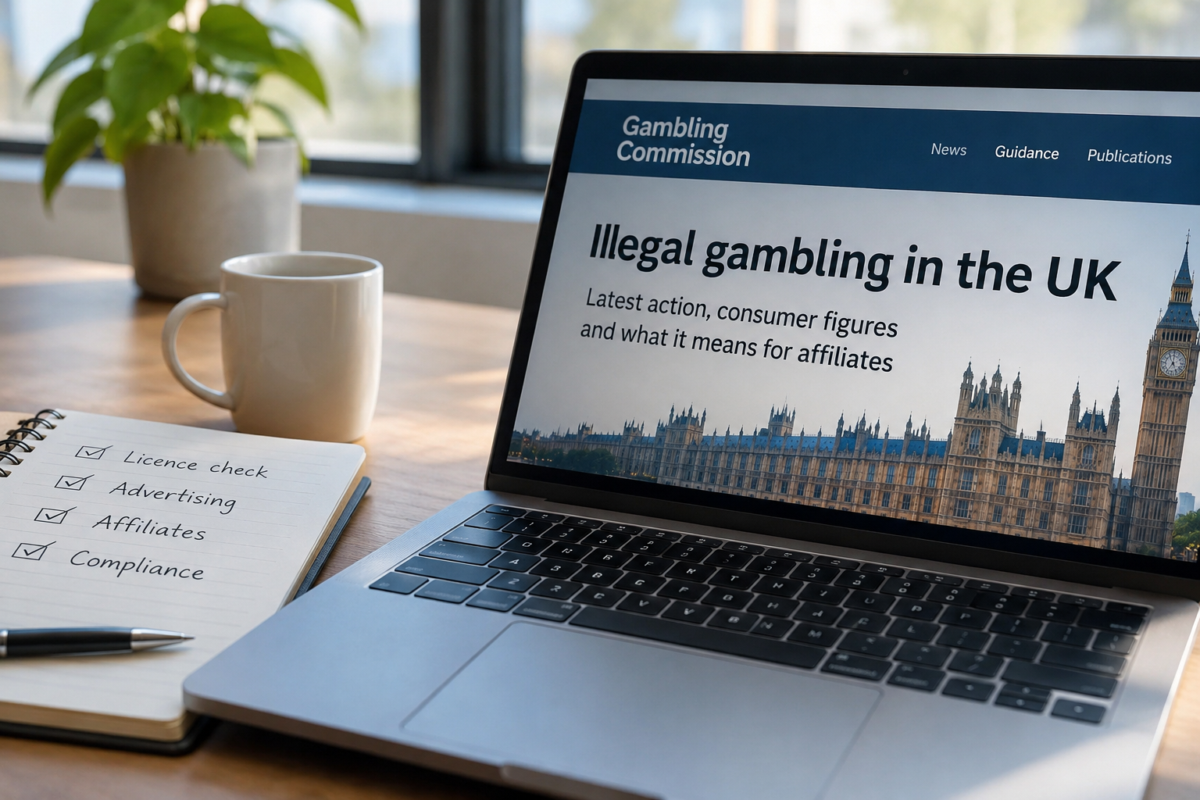
During the second quarter of 2026/27, the Gambling Commission referred 7.7 million URLs to search engines. Referrals in the preceding quarter numbered 147,721. Website takedowns, however, represent only part of the regulator’s work against illegal gambling in the UK. Its activities now also target payments, advertising and access to games.
Affiliate publishers have a particular interest in these developments. Their business depends on visibility in search results. Meanwhile, the Commission works directly with the search engines on which affiliates rely. The November announcement explains the regulator’s strategy for disruption. Recent survey findings provide further context for that work. For publishers, the legal implications concern liability for advertising brands without a licence.
What the Commission announced in November
The Commission announced its plans during the first Illegal Gambling Awareness Week. This campaign took place under the leadership of the International Association of Gaming Regulators. Two publications accompanied the announcement, covering consumer engagement estimates and the regulator’s enforcement approach.
Enforcement beyond website takedowns
On 9 November 2026 the regulator announced its intention to target illegal gambling profits and assets alongside website takedowns. Its choice of language was unusually direct for a licensing authority.
“If you run an illegal gambling operation, we are coming after you, your business and your money.”
Sue Young, Executive Director of Operations at the Gambling Commission
The announcement signals a change of emphasis rather than a new set of powers. In practice, the Commission intends to disrupt several aspects of an illegal operator’s business rather than address individual websites in isolation.
Part of this work involves disrupting payments and restricting opportunities for illegal operators to advertise. Access to games and sportsbooks is another area of intervention. In addition, the Commission has referred more than £40 million in suspected criminal funds to partner agencies since January 2026. Those referrals concern potential asset freezing. Separately, the regulator works with law enforcement to seize cash at illegal land-based gambling operations.
Growth in search engine referrals
Search engine referrals increased considerably between the first and second quarters of 2026/27. In the first quarter, the Commission recorded 147,721 referrals. By the second quarter, that figure had reached 7.7 million. This represents an increase of more than 5,000%. For 2026/27 to date, the Commission has referred 7.8 million URLs and secured the removal of 3 million URLs. It has also issued more than 1,000 cease and desist notices to illegal operators.
A URL is not a website. Through mirrors and redirects, a single operator can account for thousands of individual referrals. By comparison, the Commission’s separate figure of more than 2,200 websites referred for disruption better reflects the number of operators.
Three legal terms that determine affiliate exposure
Affiliates need to distinguish between three mechanisms with different legal effects. These operate under criminal law, regulatory licence conditions and administrative procedures.
- Section 330, Gambling Act 2005
- Section 330 makes advertising unlawful gambling a criminal offence. Liability extends to the advertiser regardless of whether that person holds a licence. Even so, the provision allows a defence based on reasonable belief. The offence predates the present disruption strategy by a considerable period. For publishers, it remains the provision with the most direct implications for their advertising activities.
- Licence condition 1.1.2
- Licensed operators remain responsible under the licence conditions for the third parties they contract with. The condition expressly covers affiliates who breach a relevant advertising code.
- Cease and desist notice
- This is an administrative measure against unlicensed operators. Although the notice carries no fine of its own, non-compliance informs subsequent disruption work.
An affiliate without a British licence falls outside the scope of condition 1.1.2. Consequently, no operator contract under that condition governs its conduct. Section 330 nevertheless applies to the affiliate. From a commercial perspective, the absence of contractual restrictions can obscure the publisher’s exposure to criminal liability.
What the figures reveal about illegal gambling in the UK
Survey responses rather than operator records form the basis of estimates of illegal gambling in the UK. On 5 November 2026 the Commission published findings from the Gambling Survey for Great Britain. These provide the first substantial indication of consumer engagement. The headline figure alone tells little. Differences between groups of respondents become apparent in the more detailed findings.
Low engagement with differences between demographic groups
Across the population, 94.4% of respondents showed no indication of illegal website use. Some 0.6% reported engagement in the past four weeks. Another 0.4% engaged earlier in the past twelve months. Among respondents who gambled online during those twelve months, the corresponding proportions increase to 2.5% and 1.5% respectively.
Engagement also varied by sex and age. Men reported greater engagement than women. Over the past twelve months, younger adults were more likely to engage with illegal sites. This was particularly apparent among those aged 18 to 24. Among adults aged 25 to 34, engagement was more apparent in the past four weeks. Sue Young observed that engagement appears low and stable. However, consumers who use illegal operators face a greater likelihood of experiencing harm.
That combination helps explain why the regulator concentrates on disruption at the point of discovery. Search results and advertising are central to that process.
Where liability arises for illegal gambling in the UK
Two distinct legal regimes determine liability for illegal gambling in the UK. Affiliates often assume that the operator alone bears responsibility for ensuring compliance with the applicable legal requirements. Licence conditions primarily bind the licensee. Criminal liability, by contrast, concerns the person responsible for publishing the advertisement.
Operator responsibility for contracted affiliates
Licensees remain accountable under licence condition 1.1.2 for third parties carrying out any aspect of their licensed activities. Contracts establish how this responsibility operates. Each agreement must require the third party to observe the same conditions and codes as the licensee. In addition, third parties must supply information necessary for the licensee’s reporting obligations. Operators must keep the contractual right to terminate promptly following a breach. The condition specifically mentions affiliates who breach a relevant advertising code.
Affiliate discussions tend to give less attention to condition 16.1.1. Its requirements on the placement of digital adverts prohibit licensees from advertising on websites that provide unauthorised access to copyrighted content. Licensees must also take reasonable steps to ensure that the third parties they contract with comply with this restriction. Again, they must keep a right of termination. Programmatic advertising therefore warrants the same scrutiny as direct advertising purchases.
Further obligations relating to marketing data appear in the Commission’s guidance on third-party marketing. The regulator considers the business primarily responsible for breaches. Licensees likewise remain responsible when an affiliate mishandles information about self-excluded customers. The Commission is unlikely to accept that reasonable steps were taken where a single mistake led to the marketing being sent.
Criminal liability for the advertiser
Advertising unlawful gambling is an offence under section 330 of the Gambling Act 2005. The Act determines whether the gambling requires a licence, permit, registration or exception. Gambling is unlawful for these purposes if the necessary arrangements were incomplete when the advertisement appeared. Following summary conviction, a court can impose up to 51 weeks of imprisonment. Alternatively, it can impose a fine at level 5 on the standard scale. Both penalties are possible. In Scotland, the custodial penalty extends to six months.
Subsection 4 provides a defence where the advertiser reasonably believed the gambling was lawful. Documenting licence checks therefore has particular legal significance. Subsection 8 treats each day of display or accessibility as a separate offence. An accessible review page can consequently give rise to continued liability long after the advertising campaign has ended.
Illegal gambling in the UK at a glance
The figures below retain their respective reference periods. Confusion between these periods accounts for the most common error when citing the published data.
| Enforcement or survey measure | Reported figure | Reference period |
|---|---|---|
| URLs referred to search engines | 7.8 million | 2026/27 to date |
| URLs removed from search results | 3 million | 2026/27 to date |
| Change in quarterly URL referrals | 147,721 rising to 7.7 million | First quarter to second quarter of 2026/27 |
| Website referrals for disruption action | More than 2,200 | 2026/27 to date |
| Cease and desist notices issued | More than 1,000 | 2026/27 to date |
| Suspected criminal funds referred for potential asset freezing | More than £40 million | Since January 2026 |
| Respondents showing no indication of illegal gambling website use | 94.4% | Survey published 5 November 2026 |
How QMRA assesses UK affiliate websites
Our legal team reviews affiliate websites targeting British players against the Gambling Act 2005 and applicable licence conditions. For each advertised brand, we verify the licence position of the exact domain receiving affiliate traffic. Brand recognition alone offers no assurance. We then examine whether inactive pages and existing redirects continue to direct visitors towards unlicensed websites. These pages present an ongoing legal risk because of the daily offence rule. Finally, our assessment covers age statements, risk warnings and references to self-exclusion support.
Records of licence checks serve a purpose beyond certification. Advertisers relying on the reasonable belief defence in section 330 need evidence to support it. Publishers need to demonstrate what they knew about the licence position when they published the advertisement. Contemporaneous records of individual checks therefore carry greater weight than general assurances offered afterwards.
We identify the jurisdictions within our remit on the list of active markets. Further information about the certification assessment procedure is available separately. Readers can also consult the list of certified affiliates to identify websites that hold certification.
Frequently asked questions
What did the Gambling Commission announce in November 2026?
On 9 November 2026 the Commission announced an enforcement approach extending beyond website takedowns. Its work now targets the finances, assets and business models of illegal operators. In practice, this involves disrupting payments and advertising alongside access to games and sportsbooks.
How widespread is illegal gambling in Great Britain?
On 5 November 2026 the Commission published estimates of engagement with illegal gambling websites. Survey responses showed no indication of illegal website use among 94.4% of respondents. Among those who gambled online in the past twelve months, 2.5% used illegal sites in the past four weeks.
Can an affiliate commit a criminal offence by promoting an unlicensed operator?
Advertising unlawful gambling is a criminal offence under section 330 of the Gambling Act 2005. Following summary conviction, a court can impose up to 51 weeks of imprisonment. Alternatively, it can impose a fine at level 5 on the standard scale. Both penalties are also possible. However, advertisers have a defence if they reasonably believed the gambling was lawful.
How long does advertising exposure last under section 330?
Under the Act, every day an advertisement remains on display or accessible counts as a separate offence. Ending an advertising campaign does not end the exposure if the original page remains accessible.
What do the licence conditions require operators to do about affiliates?
Under licence condition 1.1.2, operators remain responsible for the third parties they contract with. Contracts must require third parties to observe the same licence conditions and codes. In addition, third parties must provide information necessary for the licensee’s reporting obligations. Operators must also keep the contractual right to terminate promptly. The condition specifically refers to affiliates who breach a relevant advertising code.

