
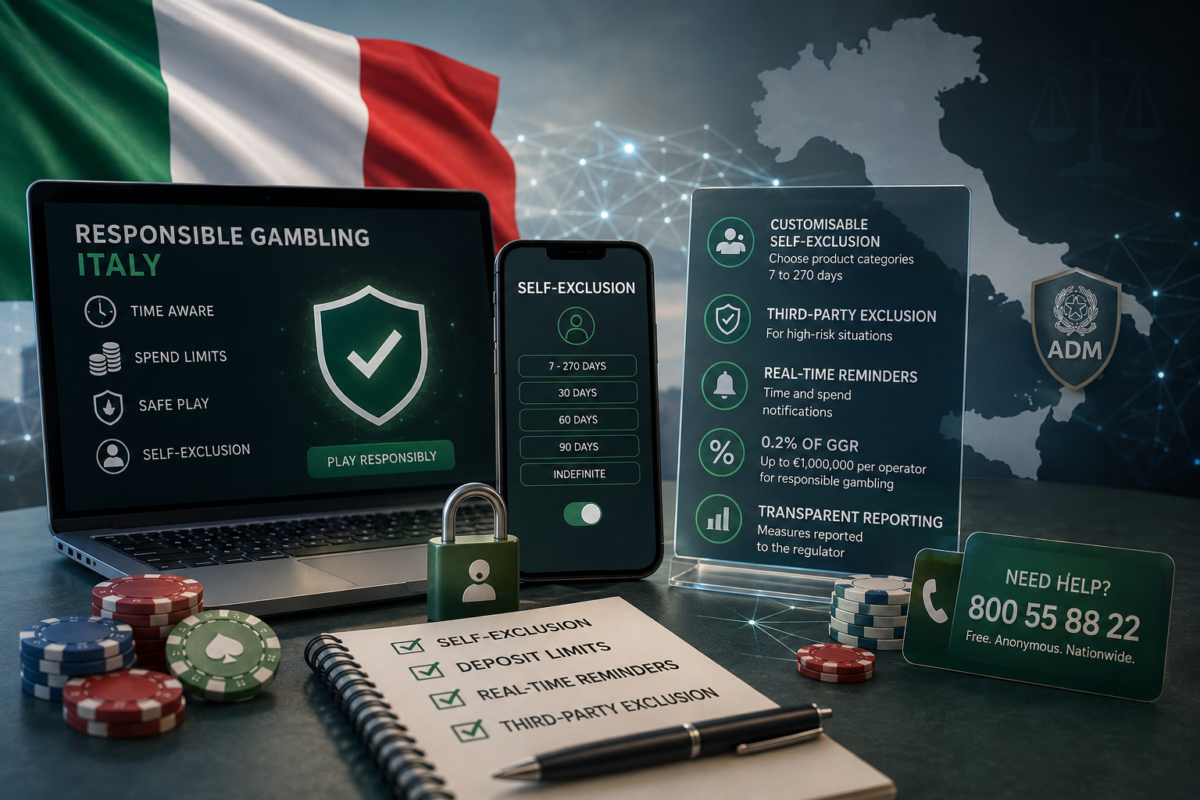
Responsible gambling in Italy changed as much as the licensing map did. In November 2025, Italy cut its licensed operator count from 407 sites to 52 licenses, the reform behind how legal gambling in Italy works today. Regulators rebuilt the safety layer underneath that market at the same time, though it drew far less press coverage than the licensing story. This piece looks at what happens once someone is already playing, and what stops that from going wrong.
Self-exclusion in Italy: from a single switch to a dimmer
The old RUA: one setting, every operator
Since its introduction, the Registro Unico degli Autoesclusi (RUA) has worked as the single national switch behind responsible gambling in Italy. A player logs in through SPID authentication and chooses a self-exclusion period of 30, 60 or 90 days, or an indefinite ban. ADM enforces that setting instantly across every licensed platform in the country. There is no partial version, and no way to keep one account open while closing another. Choosing self-exclusion has always meant leaving the entire legal market at once.
That all-or-nothing design was deliberate, and it works well for what it targets. But it also left a player who only wanted to step back from online slots, while still placing the occasional sports bet, with no legal middle ground. Some players facing exactly that dilemma had a real incentive to under-report the problem to themselves rather than lose access to everything at once.
Partial self-exclusion, live from 1 February 2026
That gap closes on 1 February 2026, when a rule change takes effect. Players will be able to restrict access to specific product categories, casino games but not sports betting, for example, rather than closing an account entirely. Coverage of the reform puts the customisable window at seven to 270 days, alongside the existing indefinite option. That gives players a middle ground between doing nothing and shutting everything down.
A second, stricter mechanism sits alongside it: third-party exclusion. Regulatory authorities or other qualifying parties can trigger it in high-risk situations, rather than waiting for the player to act first. ADM has not yet finalised the exact criteria, which is worth watching rather than treating as settled.
| Feature | Before 1 February 2026 | From 1 February 2026 |
|---|---|---|
| Scope of exclusion | Entire account, all products | Selectable by product category |
| Minimum duration | 30 days | 7 days |
| Maximum fixed duration | 90 days | 270 days |
| Indefinite option | Yes | Yes |
| Third-party initiated exclusion | Not available | Being introduced, criteria still in development |
What responsible gambling in Italy requires from operators
Real-time reminders and adaptive limits
The November 2025 reform did not stop at licensing structure. Operators must now run automated in-session messages that remind players how long they have played and how much they have spent. Each message links directly to cool-off or self-exclusion tools, rather than burying them in account settings. Spending caps must be player-configurable, and the system adjusts recommended limits based on age and observed betting patterns, rather than applying one static threshold to every account.
None of this replaces the RUA. It sits underneath it, catching risky behaviour earlier in a session rather than only offering an exit once a player has already decided something is wrong.
Who funds responsible gambling in Italy
Licensed operators must direct 0.2 percent of their annual gross gaming revenue, capped at one million Euros per operator, into responsible-gambling initiatives. They must also report those measures transparently to the regulator. That figure looks small next to license fees of seven million Euros per concession and GGR tax rates of 20.5 to 25.5 percent. But it is now mandatory rather than voluntary, and it applies uniformly across all 52 licenses now standing in for the market that used to run on 407 sites.
Getting help with responsible gambling in Italy
Outside the platforms themselves, Italy runs a national telephone support line for gambling-related harm: 800 55 88 22. The health institute ISS and ADM jointly operate it. The line is free, anonymous, and reachable regardless of which operator a player used, because it sits outside the licensing system entirely. It is there whether the site someone used was licensed or not. For a wider view of the unlicensed side of that question, see our piece on Illegal Casino Italy: Risks and Explanation.
Why responsible gambling in Italy matters for affiliate compliance
An affiliate site that links to sign-up pages but never mentions self-exclusion, deposit limits, or the national help line is not automatically breaking a rule. But it leaves out the part of the Italian framework that regulators treat as inseparable from the licence itself. Operators must now surface these tools inside the product, so review content that omits them falls out of step with the market it claims to cover.
QMRA’s compliance check on Italian affiliate sites already looks for an 18+ warning and a working link to self-exclusion resources on every site we approve. The partial self-exclusion rollout in February 2026 is the next thing we will check for by name. Our full standard for responsible gambling in Italy and other markets is set out on the QMRA homepage.

